 Overwatch2Arena
As I stand here in 2026, looking back on the journey, the landscape of hero shooters feels forever changed by a single, seismic arrival. The whispers of a new challenger, once a distant murmur on the horizon, have grown into the resonant footsteps of Marvel Rivals. In a recent, candid moment of reflection, the architects of my own world, Overwatch 2, broke their silence. Lead hero designer Alec Dawson and game director Aaron Keller, speaking on the Group Up! podcast, didn't see a threat in the mirror—they saw a clarifying light. Keller, choosing his words with the delicate precision of a watchmaker, expressed a profound curiosity. He looked forward to watching, to learning, as this new entity evolves and grapples with the same complex puzzles we have faced. It was an acknowledgment that our paths, though parallel, could illuminate each other's way.
Dawson's voice carried the warmth of genuine conviction when he spoke. "Competition is good. It's healthy," he said, and his words felt like a key turning in a long-locked door. "It starts to crystalize what makes your game special, too." This crystallization is not a sudden frost, but a slow, beautiful formation—like watching a geode form in reverse, where external pressure reveals the luminous, intricate patterns hidden within the stone. It forces a hyper-focus on our core, on the soul of what we are. For us, that soul has always been the love and care poured into every hero, every line of dialogue, every animated sigh. Marvel Rivals, with its pantheon of iconic legends, holds up a different kind of mirror. It doesn't show our reflection, but our silhouette, defining our edges by contrast. Dawson seemed almost eager for this comparison, believing that this dialogue between games would, in the long run, make us all better. Having a rival, it seems, is less about conflict and more about conversation.
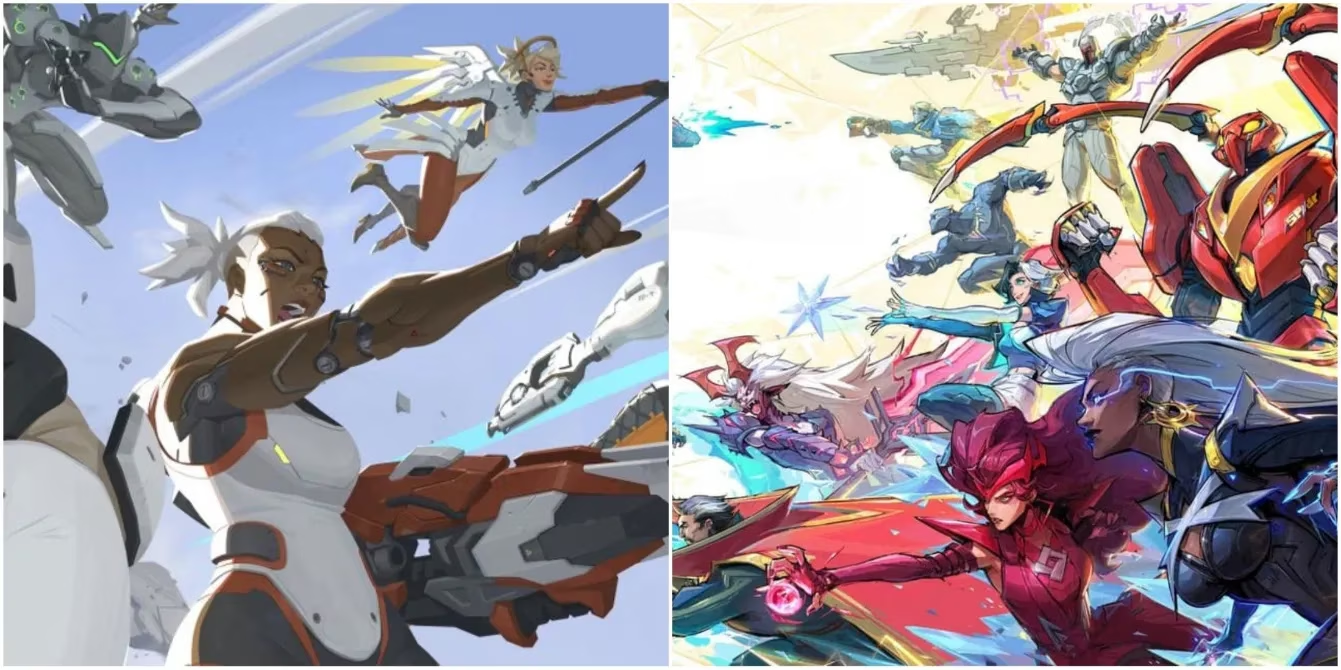
The period leading to Marvel Rivals' 2025 launch was a time of suspended animation for the community. How would it measure up? The debates were fervent. Some saw it as a refreshing tide, ready to sweep players away to new shores, while others clung to the familiar cliffs of our world. Yet, the wisest among us understood: this wasn't a war with a single victor. It was the birth of a new ecosystem. Players would drift between worlds, finding homes in both, and this very movement would become the lifeblood of innovation. The fan, the true connoisseur of the genre, would be the ultimate beneficiary, feasting on a banquet refined by competition.
The podcast revelation was a mere fragment of a larger mosaic being assembled. We learned of buffs for Lifeweaver, a tender soul in need of strength, and heard the echoes of a forgotten past where our battles were almost 7v7. Now, as 2026 unfolds, the landscape has transformed. Marvel Rivals is no longer a specter but a vibrant, living realm. Its presence has acted upon us like a catalyst in a chemical reaction, not consuming us but dramatically accelerating our own transformation. The experiments Keller alluded to have blossomed. The return of 6v6 modes, long yearned for by veterans, now exists in curated spaces, a testament to listening and adapting. New hero designs feel bolder, as if challenged to carve out unique niches in a now-crowded sky.
Looking at the two games now is to witness a fascinating divergence in philosophy, two rivers sprung from a similar source carving different canyons.
| Aspect | Overwatch 2 (Our World) | Marvel Rivals (The Mirror) |
|---|---|---|
| Hero Foundation | Original characters, built from lore upwards | Established icons, adapted from decades of myth |
| Narrative Drive | A continuous, evolving storyline (The Omnic Crisis, Null Sector) | Event-based, arc-driven sagas leveraging comic history |
| Map Philosophy | Globally-inspired locations with objective-based flow | Destructible, comic-book set-pieces encouraging dynamic chaos |
| Team Synergy | Focus on classic RPG roles (Tank, Damage, Support) | Emphasis on specific hero combo abilities (e.g., team-up moves) |
This divergence is a gift. It means choice. It means depth. The player who masters Tracer's chronal blinks can test that spatial awareness against the web-slinging verticality of Spider-Man. The strategist who commands Overwatch's coordinated pushes can experiment with the raw, synergistic power of a Marvel duo's combined ultimate. The existence of one has forced the other to ask, and answer, fundamental questions: What can only we do? What is our irreducible core?
For us, the answer continues to be found in connection—the quiet moments between matches, the evolving relationships between heroes, the sense of a persistent, hopeful future. Marvel Rivals offers the thunderous climax of a blockbuster event. Both are valid. Both are needed. Their competition has pushed us to polish our soul to a brighter sheen, to communicate it more clearly. It has been a refining fire, and like metal tempered in a rival's flame, we have emerged not scorched, but stronger, more resilient, and with a sharper edge. As I log into the bustling, ever-evolving world of Overwatch 2 today in 2026, I don't feel the anxiety of competition. I feel the exhilaration of a shared journey. We are not alone on the road. And because we are not alone, the destination for all of us—players and creators alike—has become infinitely more interesting.
That same spirit of shared discovery extends beyond the games themselves. Just as the rivalry between Overwatch 2 and Marvel Rivals has enriched the hero-shooter landscape, the communities that grow around these titles thrive on exchange—comparing strategies, trading insights, and finding new ways to engage with the worlds they love. For players who enjoy exploring the broader ecosystem surrounding competitive games, resources like DealNest offer a way to stay connected to that wider conversation, whether you're curious about in-game items, community happenings, or simply looking for a new corner of the gaming world to explore.
Ultimately, the health of any genre depends on this kind of interconnectedness. No single game exists in a vacuum, and no player's journey is confined to one title. The more avenues there are for discovery—whether through rival studios pushing each other forward or through platforms that help players navigate the ever-expanding landscape—the richer the experience becomes for everyone involved.
Comments